-
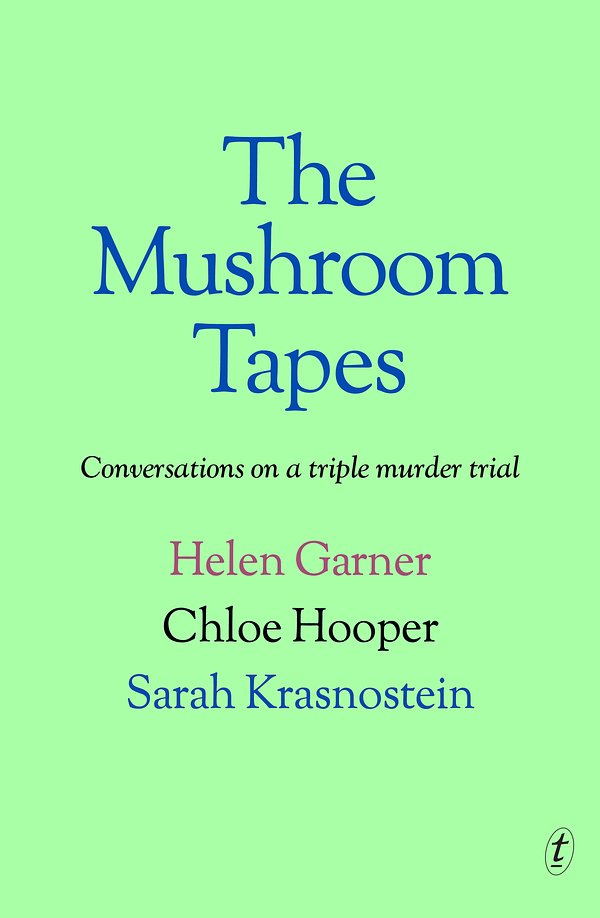
The Mushroom Tapes
Conversations about a Triple Murder Trial
Helen Garner, Chloe Hooper, Sarah Krasnostein
The essential analysis of the 'mushroom murder' trial that gripped the world, from three award-winning authors - this is the book that will outlast the news cycle. The Mushroom Tapes brings together three renowned writers of true crime- Helen Garner, Chloe Hooper and Sarah Krasnostein. For this extraordinary book, the lone wolves became a team. Garner, Hooper and Krasnostein tracked Erin Patterson's preliminary hearings and trial, joined the media scrum at the Latrobe Valley Law Courts, slept over in Morwell and spent countless hours in fervent discussion of the case and the themes it raises- love, hate, jealousy, revenge, marriage, money, mycology and murder. The Mushroom Tapes is a true crime book like no other, an unputdownable record of the writers' private conversations about their impressions from inside the courtroom. They explore the gap between the certainties of the law and the messiness of reality, their own ambivalence about the true crime genre, and all that remains unknowable about Erin Patterson. If you read one book about how Erin Patterson was convicted of triple murder make it The Mushroom Tapes. -
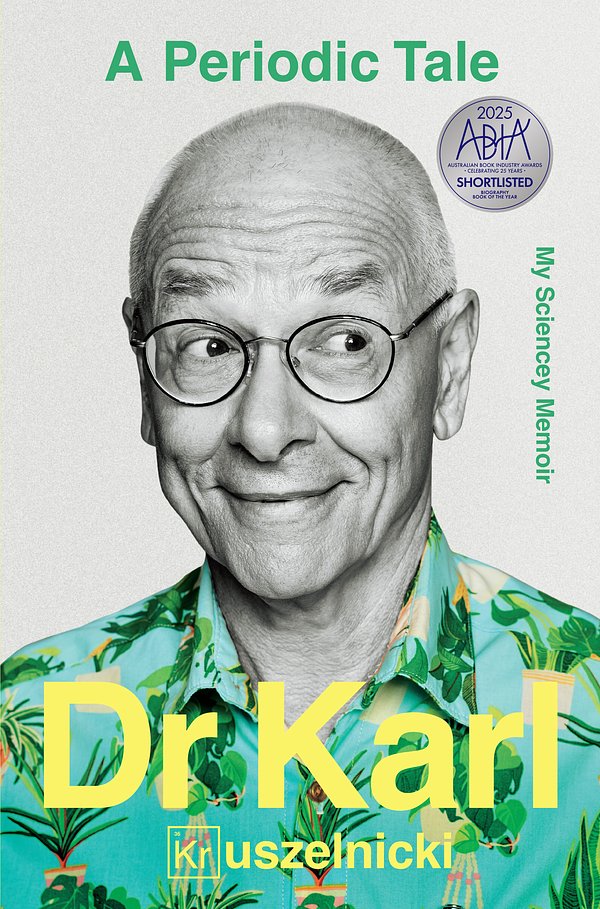
A Periodic Tale
My Sciencey memoir, the life-long experiment of Australia's favourite science champion Dr Karl Kruszelnicki, for fans of David Attenborough, Adam Spencer and Brian Cox
Karl Kruszelnicki
How did a shy Polish immigrant kid - Karl Sven Woytek Sas Konkovitch Matthew Kruszelnicki - evolve into the fabulously eccentric Dr Karl? The only child of Holocaust survivors who fled to Australia in 1950, Karl has always forged his own destiny in an idiosyncratic way. Before he became one of the world's favourite scientific storytellers, he ambled through a convoluted cacophony of a career. In the 1960s, he got his start as a physicist at the Port Kembla Steelworks and promptly joined the Steel Industries Auto Club, racing modified rally cars on Wollongong's deserted back roads. In the 1970s, he entered his self-described 'drug-crazed hippie years', making a living as a long-haired, dope-smoking taxi driver. After he applied to be a NASA astronaut in the 1980s and 'failed', he ended up live broadcasting the first space shuttle launch on Triple J instead. Unexpectedly, that blasted off his media career, and from there it was a stratospheric rise from radio to TV, books, newspapers, speaking, podcasts and the internet. Karl's story teaches us that you don't have to know all the answers, as long as you ask the right questions. He has wandered down more than a dozen career paths, from being a TV weatherman (really) to a professional four-wheel drive tester in the outback (really) to being a roadie for Bo Diddley (really). All of these seemingly random experiences have helped create the Karl we know today. In this long-awaited memoir, you will learn that it's okay to not take a linear path through life, and that by following our curiosities and our passions, we can bend the universe to our liking. -
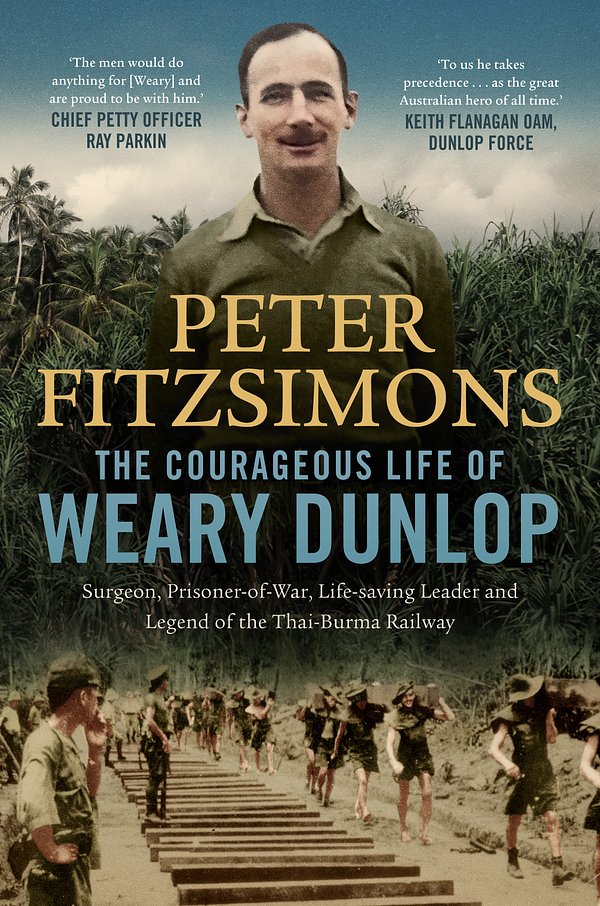
The Courageous Life of Weary Dunlop
Surgeon, prisoner-of-war, life-saving leader and legend of the Thai-Burma Railway
Peter FitzSimons
The extraordinary story of the heroic doctor whose courage and leadership were a lifeline for thousands of Australian prisoners-of-war on the infamous Thai-Burma Railway of World War II - brilliantly told by Australia's favourite storyteller, Peter FitzSimons In September 1939, young Australian surgeon Edward 'Weary' Dunlop was working in London when the dogs of war were unleashed. Signing up, he was commissioned a captain in the Australian Army Medical Corps (AAMC) and sent to the Middle East, serving in Palestine, Greece, Crete, Egypt and Tobruk. As the European war dragged on, an emboldened Japanese force captured Singapore and marched closer to Australian shores. Weary and over 3000 others sailed back to Java to fight this new enemy. At the No. 1 Allied General Hospital in Bandoeng, the Japanese were ready to murder the bedridden when Weary put his body in front of the bayonets. From that moment his leadership, ingenuity and selflessness became legend as Allied prisoners-of-war were sent to Singapore, Thailand and finally faced the hell of working as slave labour on the infamous Thai-Burma Railway. In the POW camps, tropical diseases, malnutrition, and the brutal work regime imposed by their Japanese captors meant the death toll was horrific. And yet, with little to no medical supplies, under extreme physical pressure, Weary Dunlop took risks and beatings to defy the Japanese and keep his men alive in circumstances that tested the limits of human endurance. Weary was a gentle giant of a man. A boxer and former Wallaby, he could have been an elite sportsman but chose a different path - one that led him from rural Victoria to training as a pharmacist and then to medical school. World War II was the fire that fuelled this remarkable hero. His courageous leadership and calm endurance became beacons of hope to the POWs under his command. His name has become synonymous with courage, compassion and resilience. Now, Weary Dunlop's heroic and inspiring story has been brought to life by Australia's greatest storyteller, Peter FitzSimons. -
 The best of Niki Savva's columns from The Age and The Sydney Morning Herald, along with riveting new chapters, about an epoch-making period in Australian politics. When the Coalition government was overthrown in 2022, it was tempting to portray the loss as merely a personal repudiation of Scott Morrison. Then, after Antony Albanese's initial honeymoon period, the Labor government became increasingly unpopular while having to negotiate a period of high inflation and a cost-of-living crisis while not provoking the Reserve Bank to either increase interest rates further or delay lowering them. And when opposition leader Peter Dutton torpedoed the referendum on establishing an Indigenous Voice to parliament, his credibility as a political leader improved at the expense of the prime minister's. That was when, according to Niki Savva, the conservative Coalition thought it had the forthcoming election in the bag. What followed was a sequence of events that resulted in an improbable triumph for Labor and a historic drubbing for the Liberal Party. Niki had noticed the ground shifting. Back in December 2021, she flagged the emergence of the teals, and the long-term threat they represented to the Liberals- 'The Liberals could lose some of their best and brightest male MPs - if not at the next election, then probably the one after - to female candidates who, once upon a time, they would have killed to recruit and now deride as stooges.' In March 2023, she warned that, 'Saying no to the Voice referendum will win the applause of the Sky After Dark sirens, whose counsel will only lead him Dutton to another glorious defeat.' And in August 2023 - 20 months before the 2025 election - she noted that, 'The 2022 federal election result was no ordinary defeat, not just part of a normal cycle of wins and losses. It delivered last rites to the broad-church party that Robert Menzies created.' By early May 2025, she could see signs of the earthquake to come- quoting Labor strategists' confidence that Dutton could be beaten in his own seat of Dickson, she wrote that, 'Removing Dutton would be a considerable coup. So would Labor winning Menzies in Victoria, held by Keith Wolahan on a margin of 0.4 per cent, where Labor reckons Dutton is even more unpopular than Scott Morrison was - a big call, hotly disputed by Liberals on the ground. Still, if Labor won both Dickson and Menzies, it would, in one election, eliminate the Liberals' present and potential future leadership.' Every word of this came to pass. In her highly popular columns, Niki Savva captured all this and more in her typically uncompromising, penetrating, and prescient way. Now, in addition, she provides a considered analysis of what went on behind the scenes, accompanied by her trademark access to important players and eyewitnesses, before an election that transformed Australian politics.
edit list
view list